
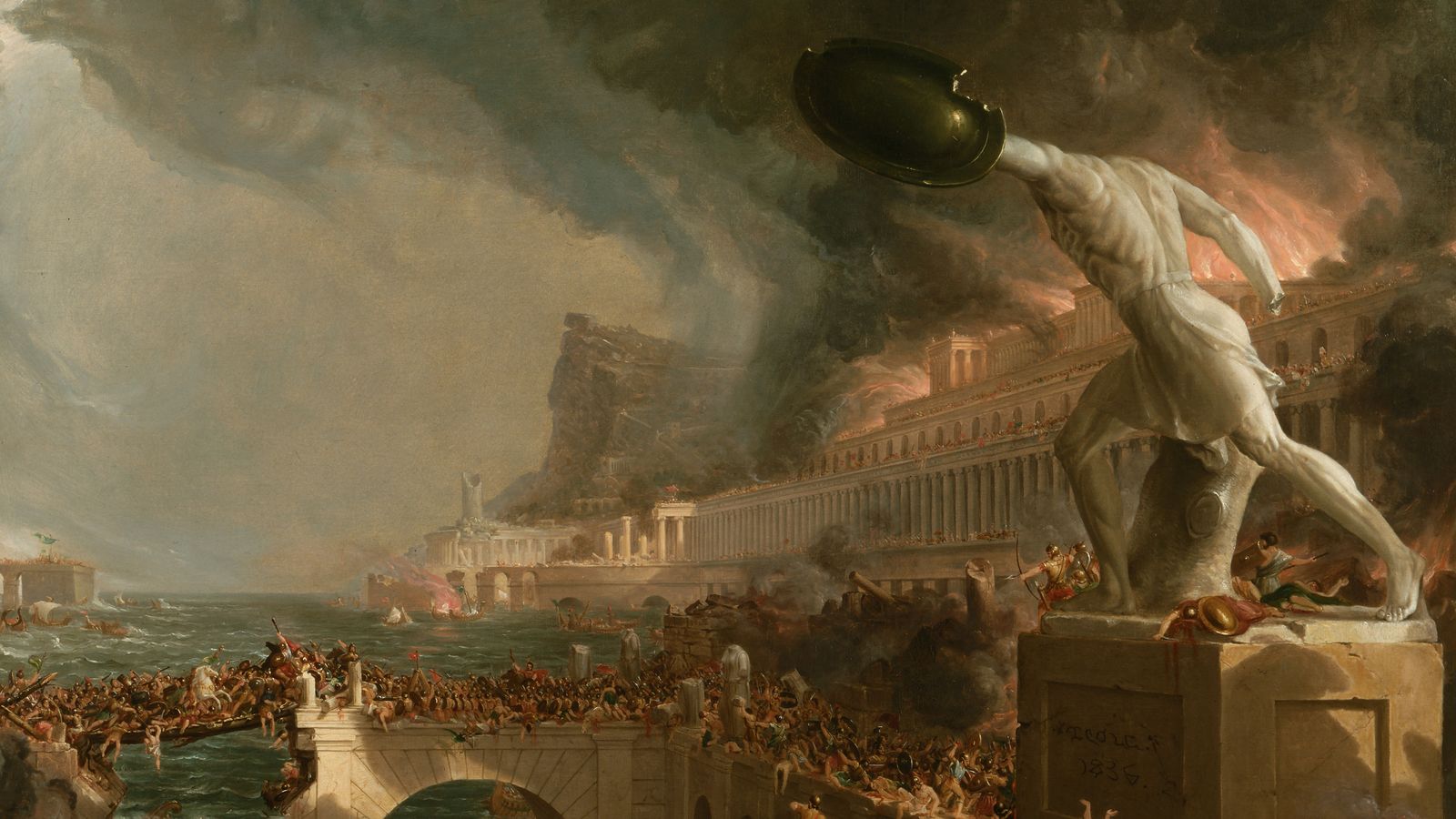
Most answers to this start with barbarians at the gates in 476. Almost every part of that picture is wrong, and pulling it apart turns out to be the quickest way into what did happen.
1. Nobody alive in 476 thought the empire had ended
The textbook date is 4 September 476, when a Germanic officer called Odoacer removed the teenage emperor Romulus Augustulus. Not one contemporary writer describes it as the end of anything.
Odoacer did not take the throne. He packed the western imperial regalia into a crate, shipped it to Constantinople, and sent a note saying the west no longer needed an emperor of its own. Then he governed Italy in the eastern emperor’s name, which is more or less what the last few western generals had been doing anyway.
2. The boy who was deposed was never really emperor
Romulus Augustulus was about fifteen. His father Orestes, a general, had installed him ten months earlier after pushing out the man before him.
Constantinople never recognised the boy. As far as the East was concerned the legitimate western emperor was Julius Nepos, living in exile in Dalmatia, and Nepos outlived the deposition by four years.
- 474
Julius Nepos becomes western emperor, recognised by Constantinople.
- 475
Orestes drives Nepos out and installs his son, Romulus Augustulus.
- Sep 476
Odoacer deposes Romulus and sends the imperial regalia east.
- 480
Nepos is murdered in Dalmatia, still the recognised emperor.
3. Rome was not the capital, and had not been for seventy years
Barbarians at the gates of Rome, the empire falling with the city: it is a vivid image and it is the wrong one. The western court had moved to Ravenna in 402, picked because it sat behind marshes and could be resupplied by sea.
So the emperor deposed in 476 was deposed at Ravenna. Rome by then was a large, shrinking city with enormous symbolic weight and no political function. Being sacked hurt. It did not decide anything.
4. Half the empire carried on for another thousand years
The empire had been split administratively since 285. The eastern half, run from Constantinople, did not fall in 476 or anywhere near it. It went on calling itself Roman, kept Roman law, and lasted until 1453 – closer to us than to Augustus.
The west
Capital at Ravenna from 402.
Last emperor deposed 476.
Tax base fragmenting; armies paid in land and bargains.
Succeeded by Germanic kingdoms that kept much of the machinery.
The east
Capital at Constantinople from 330.
Emperors continuously until 1453.
Richer provinces, shorter frontier, taxes still collected.
Called itself Roman to the end.
5. So the question has to change
Given all that, “when did Rome fall?” stops being a useful question. A better one is about capability: why did Roman government in the west stop being able to do the things Roman government used to do?
Raise taxes. Field an army it paid itself. Keep the roads safe. Move grain across the Mediterranean on schedule. Those went one at a time, over roughly two centuries, and 476 is a marker somebody placed on the wreckage afterwards.
6. The famous answer is two hundred years old and mostly wrong
Edward Gibbon’s Decline and Fall, published from 1776, blamed Christianity for draining civic virtue and barbarism for finishing the job. It is a magnificent book, and it set the terms of the argument for two centuries.
Modern historians have largely abandoned it, for a reason that is easy to state and hard to answer.
- Gibbon’s claimChristianity turned Romans away from the civic and military duty the empire ran on.
- The problemThe east was at least as Christian, and the east survived another thousand years.
- What that leavesAny answer has to explain the difference between the halves, not the thing they had in common.
7. The real near-death happened two centuries early
Between 235 and 284 the empire came apart and was put back together. Plague swept through, the frontier broke in several places at once, and two large pieces – Gaul and Palmyra – spent more than a decade running themselves.
It survived. But Diocletian’s recovery rebuilt the state as something harder and far more expensive: more soldiers, more officials, and the taxes to pay for both. Every emperor after him inherited that bill.
8. The money stopped working
Rome had no way to borrow at scale, so emperors under pressure did the one thing available and put less silver in the coins. It worked for a while. Then it stopped working, quite suddenly, in the middle of the third century.
Soldiers worked it out and started demanding payment in goods and land instead. That is a lever a state does not get back. The later empire increasingly paid in kind, in grants, and in private arrangements with the men who actually commanded troops.
9. Adrianople, and the army that could not be replaced
At Adrianople in 378 a Gothic army destroyed an eastern field army and killed the emperor Valens. Rome had lost battles that badly before and rebuilt each time. This rebuilding went slower, and the replacements increasingly came from the same peoples Rome had been fighting.
By itself that was survivable. Rome had absorbed outsiders for six centuries. What made it fatal was money: a western state too poor to pay its soldiers reliably found their loyalty attaching to their commanders instead. Odoacer, a century later, is the last line of that story rather than the first.
10. Knowledge check
Gibbon blamed Christianity for the fall of Rome. What is the strongest objection to that argument?
Pick one to see the answer.
What the rest of the course covers
Chapter one takes the standard story apart. The remaining four chapters build the replacement.
- The tax base. Where imperial money actually came from, why the west’s was more fragile than the east’s, and what happened when provinces stopped remitting.
- The people on the move. Who the “barbarians” were, why they were arriving when they did, and the Hunnic pressure pushing them west.
- Fall, or transformation? The argument historians are still having, and what pottery and cattle bones contribute to it.
- What survived. Law, language, the church, and why medieval Europe kept trying to restart an empire that had supposedly ended.
That is roughly forty more cards. Doomlearning writes them around your level and how deep you want to go. Ask it something else entirely and it builds that course instead.
Written by AI and checked by us before publishing. To read more, try Peter Heather, Bryan Ward-Perkins and Peter Brown. They don’t agree with each other, which makes reading all three worthwhile.