
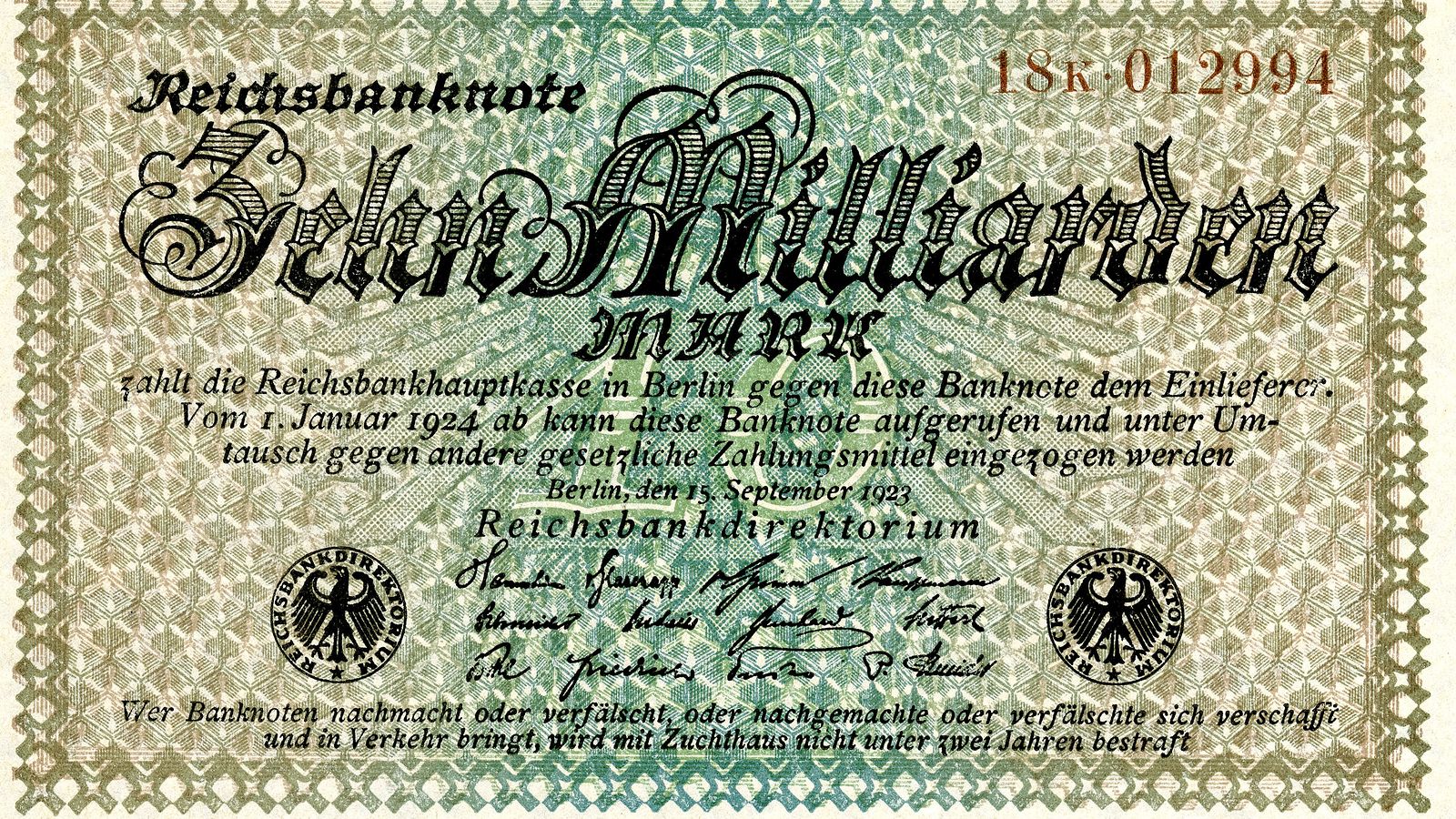
In 1923 Germans really did carry banknotes in wheelbarrows. That picture is famous enough that it has crowded out the version people actually live through, which is quieter: the same weekly shop, four pounds dearer, every year, until a wage that felt fine no longer does.
1. Nothing got more valuable
Start with what inflation is not. When prices rise across the board, it is not that bread and rent and haircuts all independently became more desirable in the same year.
Something happened to the thing they are all measured in. Inflation is a fact about money, not about bread — which is why it shows up everywhere at once rather than in one aisle.
2. The textbook answer, and why it is only half
The standard line is that inflation is too much money chasing too few goods. Double the money in circulation, hold the goods fixed, and you would expect prices to roughly double.
That is genuinely right about hyperinflations. Weimar Germany, Zimbabwe, Venezuela: in every case a government was printing money to pay its bills because it could not tax or borrow enough. But it turns out to be a poor guide to the ordinary 2-to-10% inflation that most countries actually experience, and the last fifteen years made that embarrassingly clear.
3. The decade that broke the simple story
After 2008 central banks created money on a scale without precedent. Economists predicted inflation. Some predicted a great deal of it.
Japan ran the experiment for longer and harder and spent most of three decades fighting deflation. So new money does not mechanically become higher prices. Something has to carry it into the shops, and after 2008 most of it sat in bank reserves instead.
4. Then 2021 happened, and it happened everywhere
Inflation returned across most of the developed world at roughly the same time, peaking around 9% in the US and UK and over 10% in the euro area. Three things arrived together.
- DemandPandemic support payments plus savings that could not be spent for eighteen months, released at once.
- SupplyShipping, semiconductors and labour all constrained simultaneously. The world could not make enough of anything.
- EnergyGas prices spiked after the invasion of Ukraine, and energy is an input to the price of nearly everything else.
5. Two engines, and they need different fixes
Economists split causes into demand-pull and cost-push, and the distinction matters because the standard remedy only works on one of them.
Demand-pull
Buyers have more money than there are goods.
Output tends to rise alongside prices.
Raising interest rates works: it cools spending.
Cost-push
Inputs get dearer — oil, wages, shipping.
Output tends to fall while prices rise.
Rate rises do not make oil cheaper. They just cool the economy anyway.
6. Expectations do more work than anything else
Here is the mechanism that surprises people. If everybody expects 5% inflation next year, workers ask for 5% more, firms build 5% into their price lists, and lenders add 5% to what they charge.
Those decisions produce roughly 5% inflation. The expectation was the cause. This is why central bankers talk about credibility as though it were a policy instrument — it is one. A central bank that is believed when it says inflation will come down needs to do considerably less to bring it down.
7. Which is why anchoring is the whole game
The 1970s got out of hand partly because expectations came unanchored. Once people stopped believing inflation was temporary, they started acting on that, and the acting made it permanent.
Paul Volcker broke the cycle at the start of the 1980s by raising US rates to around 20%. It worked. It also produced the worst recession since the 1930s, and unemployment near 11%. That is the price of letting expectations go, and it is the memory that shapes how central banks behave now.
8. A little inflation is the target on purpose
Most central banks aim for about 2%, and it is fair to ask why the target is not zero.
Two reasons. Falling prices are worse: if things will be cheaper next month, buying is postponed, which reduces demand, which lowers prices further. Japan spent decades in that trap. And a small positive rate leaves the bank somewhere to cut from in a crisis, which a zero target does not.
9. It does not land on everyone equally
The headline figure is an average across a basket of goods, and almost nobody buys the average basket.
If your spending skews towards food and energy — which is what low-income spending looks like — your inflation rate runs above the headline, because those are the volatile components. Inflation also quietly transfers money from lenders to borrowers, since debts are repaid in money worth less than the money that was lent. A fixed mortgage gets easier to service. Savings in cash get smaller in real terms while the number in the account stays the same.
10. Knowledge check
Central banks created enormous amounts of money after 2008. Why did consumer prices barely move?
Pick one to see the answer.
What the rest of the course covers
Chapter one is about causes. The remaining four chapters are about measurement, remedies and consequences.
- How it is measured. CPI versus RPI versus core, what a hedonic adjustment is, and the real arguments about whether the number is right.
- How it gets controlled. Interest rates, the transmission mechanism, and why the effect arrives twelve to eighteen months late.
- Hyperinflation. Weimar, Zimbabwe, Venezuela — what makes the difference between 10% and 10,000%.
- Living with it. What inflation does to wages, debts, pensions and savings, and which of the standard hedges hold up.
Roughly forty more cards. Doomlearning pitches them at your level, and will build a course on something else entirely if you ask.
Written by AI and checked by us before publishing. It isn’t financial advice.